
Showing posts with label Fainting Fit Count. Show all posts

Monday, August 22, 2016

"I have heard a tale of horror"

Eh.... Not really.

Okay, Matilda, I did forget you. And I remember why I didn't finish this novel. Because after the horrors of the castle, it gets boring.


After the whole Gossip Gothic thing they go to England and the Marquis settles it with Uncle/Not-Uncle Weimar that Matilda has a year to find her parents before he can carry her away. And everyone settles down to happiness and so forth.
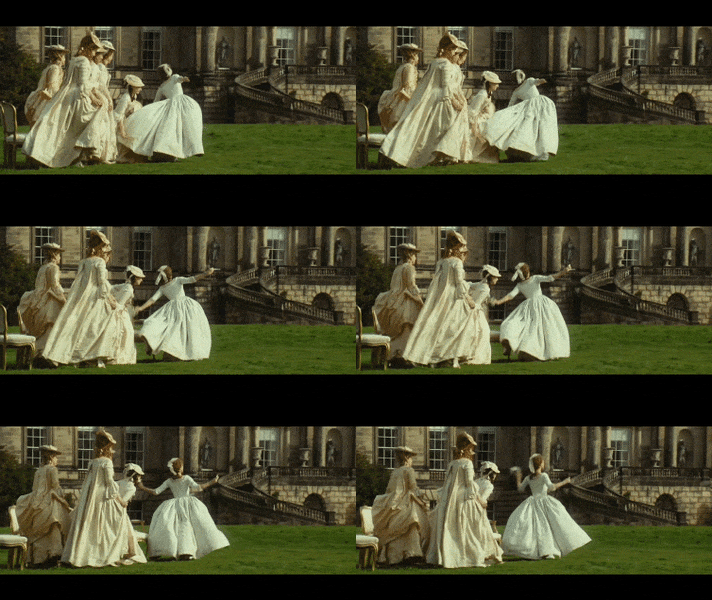

The Countess Wolfenbach managed to escape being kidnapped (like Joseph because a fortuitous carriage of nobles just happen to be randomly travelling through this out of the way woodland and just happens to see her and stop. It's amazing how many nobles go through this place.
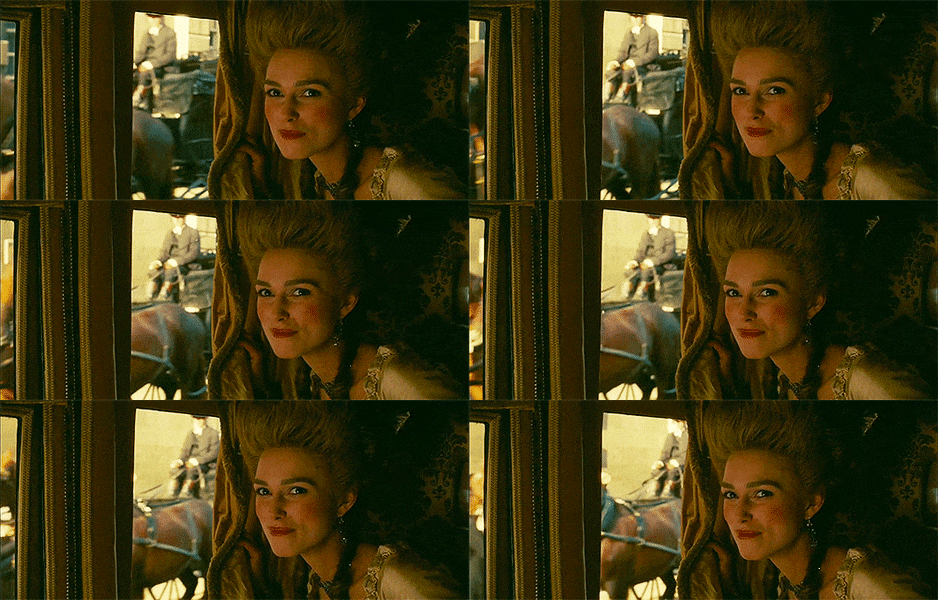

And the Countess manages to find Matilda and company in England and they all settle down to "the delights of love and friendship, in little excursions round the neighborhood, and in viewing the delightful prospects the Surrey hills afforded them. 
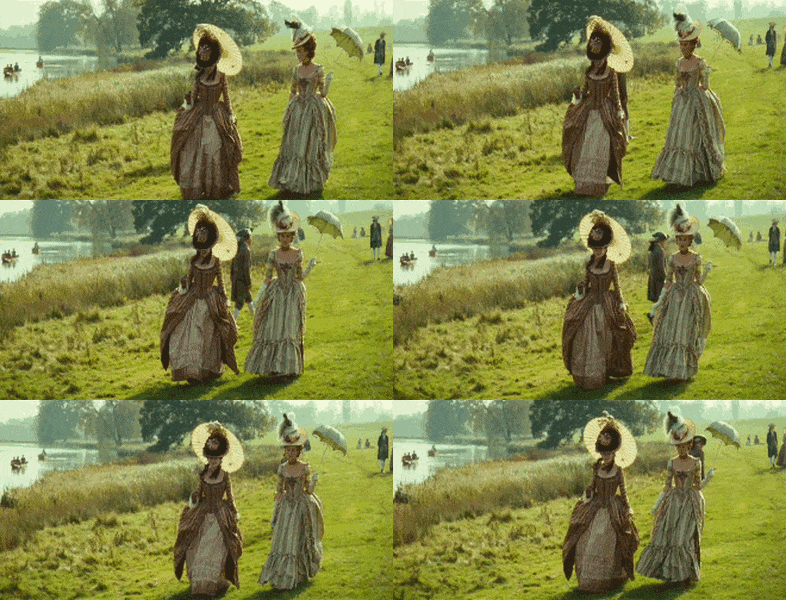

We finally learn the Countess's story. She was forced to marry Count Wolfenbach but her heart loved another man, a poor chevalier. 
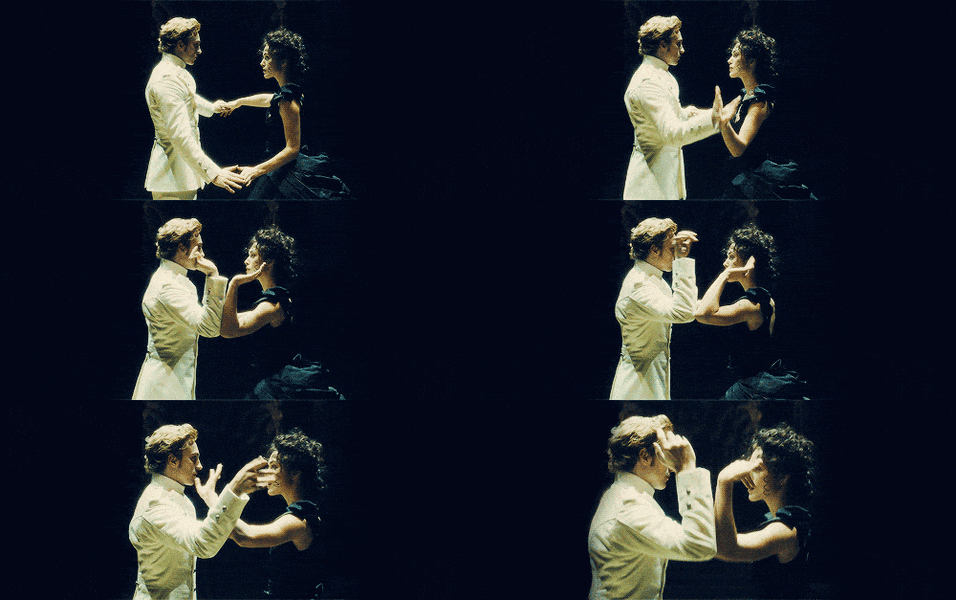
What is with their arm movements here?

He did ask her father for her hand in marriage, but he didn't have the title, the position, or the money. So she was forced to marry the evil count. He's the jealous sort and takes her off to the secluded country. But the chevalier won't give up and finds her. He slips a note through her window and she rebukes him, tears it up and tells him to go away.


But he won't. The Count discovers him, refuses to believe that she wasn't a part of it. Violence ensues and the Chevalier is murdered.

The Count takes the Countess's baby (oh, yeah, she was pregnant) and locks her away in Castle Wolfenbach with two attendants (Joseph and the woman murdered in the kidnapping). He says if she tries to escape or tells anyone anything that he will harm the child, so she swears, "taking a solemn oath, with the sacrament, that without [the Count's] permission [she] will never reveal" the murder or mention the Chevalier or contradict the Count's report that she is dead. Because, the Count says, "I prefer revenge to my own quiet; because I will be feared, and make your destiny hand on my pleasure." To keep the child safe, she agrees.

Dammit, now I will have that song stuck in my head all day.

Then Matilda shows up, the Count hears word of it, assumes the Countess broke her oath, and hence the kidnapping, etc. Which get's us to where we were in England all happy and having fun.

Aaaaand this has now lost all gothic and horridness. 



It is among the novels Isabella recommends to Catherine in Northanger Abbey. Catherine even asks, "but are they all horrid, are you sure they are all horrid?" Isabella assures her they are. 


Ah well. Not Isabella's worst crime as a friend and we'll hope the other recommendations are better. Anything called Necromancer of the Black Forest does have to be truly horrid, doesn't it?

I digress. To further the plot Parson's needs Matilda to get away from all the fun and protection in England. So Matilda decides that she is miserable.


She goes off to a convent in France and now out of the Marquis's protection, Uncle Weimar breaks the year long restraining order that was in effect in England and spirits her away. Because who didn't see that one coming?


The Countess's problems are all solved when Count Wolfenbach suddenly gets ill and on the verge of dying is gripped with remorse and confesses everything.


He explains he was a man obsessed with her and full of jealousy and love and that is why he made her life a hell and murdered people. He asks her forgiveness. She forgives him and he dies, telling her what happened to the child.

Meanwhile Uncle Weimar takes her across the sea, where they are beset by pirates. He tries to kill her and then himself as the ship is boarded (can't blame him, pirates were not good and what they were going to do to people captured was going to be horrific). But he fails and it turns out the pirates who have captured them just so happen to be good pirates, who impressed by Matilda's countenance, decide to help her.


Uncle Weimar, believing he is dying from the wound he gave himself as they were being boarded, then is filled with remorse and confesses everything. Because, hey, why not use it twice in one book? (Turns out she was absolutely right about what he meant by going into her room at night and making himself "happy.") He begs forgiveness. Matilda forgives him everything. (Honestly, by the end Matilda and Co. were so virtuous that I hated them.)



Incidentally, Uncle Weimar doesn't die, but still filled with remorse goes to become a monk. Turns out that Matilda comes from Italian nobility and is therefore able to return to her friends. She meets her mother. The Countess meets her son. Various people get happily coupled off and married. Everyone faints a lot.



It's too bad. It started out so well, with every proper cliche and a lot of fun. Then it lamed out like a Stephen King novel.



But for the next book, I am straying from Isabella Thorpe's recommendations and reading what is considered to be one of the most frightful and atmospheric books of all time.


Fainting fit count: 18

Thursday, May 12, 2016

"she turns out to be an imposter, and a shocking creature"

ELIZA PARSONS YOU ARE DOING IT ALL WRONG AGAIN!!!!!!!


MUST I EXPLAIN ABOUT THE LOVE THING OVER AND OVER AND OVER AGAIN?

But more on this in a bit.

Things start coming fast and furious and a lot is happening and there is an emotional roller coaster. In the next few posts the fainting fit count trebles. Prepare for all the emotions.


And there will be a lot of hearkening back to previous things in the next few posts, but I'll put in links for the previous posts and also put the relevant bits in so you don't need to go hunting for it all.

We stop for a bit to spend a lot of time where a bunch of French nobles talk about how England is so much superior to France in so many ways, which is so utterly ridiculous I did a post on that the first time.

The good Count De Bouville does indeed like Matilda and she likes him back. But neither of them seem to recognize this or why this is. Matilda just decides to dress up for a thing she knows the count will be at and "for the first time in her life, took some pains with her dress, and felt an anxiety about her appearance." And she has no idea why. "Unconscious of her motives, she attributed them solely to a desire of pleasing the Marchioness."

Right. Sure. Ummmm.


The good count is just as clueless, "he scarcely knew the nature of the sentiments he entertained for Matilda."


Parsons, really? You can't have the lovers be ambivalent to each other at first!! That's not how this works. You finally add in a man who isn't either married or creepy, hint attraction, and then they go about being sensible about it! Wrong! They need to fall in love! Immediately! Right now!


 But at least he good count does favor Matilda enough to make the mean girl from the assembly So after the assembly, where everyone loves everyone (except one old "coquet" who is too into flirting with men, and her niece, an 18th century mean girl, who has also taken up the habit. She's determined to gain the affection of Adelaide's brother, the Count De Bouville--foreshadowing, bet he falls for Matilda and she gets shit from that woman--oh wait. I've already read the book once... Anyway Parsons calls the old aunt of the mean girl a "ridiculous old woman.")who had designs on him really jealous. Jealous enough to cause trouble.


So the mean girl (Mme De Fontelle, by the way) lets slip a bit of information to Matilda. "I forgot to ask if you have a relation of your name now in Paris?" Matilda, of course blanches at this information, and trembles, and everyone notices this. Mme De Fontelle strikes harder, "Bless me! Has my question disordered you; I only asked because I was in the company yesterday with a gentleman of your name, just arrived from Germany."

Matilda faints.


So the evil uncle has come back and told De Fontelle everything, in the worst light ever, and De Fontelle loves it. "She's run away from his house with a servant, and jointly robbed him of his property, and now has contrived to impose herself upon the Marchioness for a different person."


And so does everyone else in town. The Marchioness goes out to find out how far it has spread and "to her great mortification she was told of it everywhere, some condoled with her on being so greatly imposed upon, others affected to resent such a creature should have the assurance to get herself introduced into company, but all agreed, 'They saw what she was, nothing but a little pretender, who was a stranger to good breading; no body was deceived but the Marchioness, for every one could see art and duplicity in her face.'"


A complete turn around from their opinion when on "the preceding evening [Matilda] was the most delightful, most engaging, most elegant girl in the world."

Don't worry. The Marchioness comes from a time when insults had class.

These days, someone known for their insults says "fuck" a lot and things like this:


The Marchioness, oh no. It's going down.
The Marchioness congratulated the ladies on their ingenuity, in finding every virtue and every vice, every charm and deformity in the same person, within the space of eight and forty hours. Their candour and good nature was highly commendable and the compliments they paid her judgment were certainly very flattering.
 Now that's using some wit and irony in a put down.


Fainting Fit Count: 3

Friday, April 22, 2016

"on Monday next you become his wife--see that you obey"


At last we learn something of the put upon Victoria's story!!! We've been through all this stuff--and speaking of, the Marchioness and Matilda talked about it right when Matilda got there but then they put it off AGAIN! So its only after the ball and all of this, under duress, that the Marchioness finally gives up the goods.

Aaaaaaand it turns out she doesn't really know much.


More on that in a bit.

So after the assembly, where everyone loves everyone (except one old "coquet" who is too into flirting with men, and her niece, an 18th century mean girl, who has also taken up the habit. She's determined to gain the affection of Adelaide's brother, the Count De Bouville--foreshadowing, bet he falls for Matilda and she gets shit from that woman--oh wait. I've already read the book once... Anyway Parsons calls the old aunt of the mean girl a "ridiculous old woman.")


Right. I digressed again. All the women loved each other. Matilda in a moment alone sighs for her terrible life of ending up loved and with a rich family that just wants to make her happy, saying, "Is it possible any one can be more unfortunately circumstanced than myself?"


Seriously, Matilda? I can name a couple. Like your kidnapped friend, Victoria. She's probably not having nearly as much fun.


Not to mention, Matilda, you really haven't seen much of the world and none of it real poverty.


Seriously, STAHP!!!


Parsons then stops the narrative completely to create a defense of French female propriety to her English audience.


Apparently the English enjoyed stereotyping all French women as profligate and too free with their bodies and emotions. Parsons insists this is more of a "national gaiety of heart and freedom of manners" that develops because they are far more restrictive of young women than the English are, and that "most are truly respectable in every situation in life."

I'm failing to really give you an idea of how hilarious this this little, sudden defense of French womanhood is. (It's a lot easier to make fun of serious bits.) So I'm just going to give you a little taste of the passage.

Therefore 'tis no uncommon thing for girls gladly to marry the man pointed out by the parents if he is ever so old, ugly, or little known; the restraint laid upon them is so strict, and their conduct so narrowly observed, that to enjoy liberty they have to marry
For those who have studied the characters and manners of the French ladies declare, there is more semblance than reality of vice in them. 


But the bright reverie of ignoring Victoria is kidnapped by horrible people and instead attending assemblies, enjoying the company of women and snubbing men, is suddenly broken in upon by Matilda getting a letter from Joseph telling her about the visit from her terrible uncle and that he now knew she was in Paris. Matilda goes into hysterics (but sadly does not faint).  "She was terrified and shocked beyond measure, she sunk into a chair, and burst into a flood of tears."

The Marchioness and Marquis notice Matilda is upset, ask why, and she tells them of her evil uncle on his way to Paris. The Marquis prmises to protect her and the Marchioness decides they should stay in this morning, telling Matilda, "to amuse you from thinking of your own troubles, I will enter upon the story of my unfortunate sister." Because nothing is more amusing than tales of other people's tragedies, right?


It starts the way all these stories should. Once upon a time (okay, Parsons doesn't go quite that far, but may as well have) there were two beautiful daughters of a Baron-- Baron Stielberg.  The Baron loved nothing so much as money and the pride of his family name. But the bad financial decisions of his ancestors had left him his proud family name, but not the money expected as his right as a noble. And as he had no son who could turn the family fortunes around, but only two useless daughters, he decided the only thing to do was to marry the girls off to the best advantage possible. Upon being old enough to enter into society, the elder sister, only 16, meets the Marquis. They are taken with each other and the Marquis makes an offer for the elder sister's hand in marriage. Though the old Baron would have preferred a German noble to a French one, he cannot ignore the Marquis' consequence and money and so he agrees. The Marchioness marries the Marquis and "became the happy wife of one of the best of men." But this left the younger sister, the unfortunate Victoria, with the old Baron and he is determined to marry her off as soon as he can.


A bit later, Victoria, who is only about 14 or 15, meets a nice young man "of a noble family, but small fortune" and falls in love. The Marchioness feels this is an ill omen. "I was sorry for it, I knew he would never be countenanced by my father." At the same time, the Count of Wolfenbach, who has a title and an immense fortune, has become obsessed with Victoria and is pretty much stalking her. And, of course this wouldn't be a gothic tale if the Count wasn't evil. And it wouldn't be a story if Victoria at all liked him. And, as sure as you can guess the plot of this summer's blockbuster before you even walk in the theater, you know the father will force Victoria to marry the evil Count.

Which is what happens. Victoria writes her sister, "I was commanded to receive Count Wolfenbach as my destined husband! I hate, I detest him-- he is morose, savage, sneering, revengeful--Alas! what am I saying? this man may be my husband O, my dear sister, death is far preferable." (No, I didn't screw up the typing. That is the punctuation. It took all my power not to correct it.)

Victoria tries to get herself out of it, the Marquis offers the Baron a third of his fortune to try to get her out of it, the nice noble Victoria is in love with makes an offer of marriage. Nope. The Baron is determined, saying, "the Count has a noble fortune, high birth, a title, and is a German--not another word. Not a single objection; on Monday next you become his wife--see that you obey without the least reluctance."

Victoria faints. (#2! Evil counts notwithstanding, I was beginning to wonder if this book was really a Gothic.)

Victoria, after waking up again, argues with the Count saying she doesn't love him, she loves another, and that, "no man of spirit could bear a divided heart... your Lordship will do well, both for your own sake and mine, to renounce all thoughts of me." This pisses off the evil Count who say, "You shall be mine, let the consequence be what it may," and then "flung out of the room with a look of vengeance."


The nice noble leaves the country and Victoria is "sacrificed to his rival." (I love the wording there.)

Less than a year later, the Baron dies, suddenly. The Marquis and Marchioness travel to Germany to help settle affairs and the Marchioness meets Count Wolfenbach. "Never surely was there a man with a more ferocious countenance, he inspired me with horror the moment I examined him." She finds Victoria much altered. Silent, reserved, and having lost her bloom. She is also pregnant and tells the Marchioness that she will probably die in childbirth. The Marchioness later also learns from a friend that Count Wolfenbach had been married before.


The friend tells her of it with all the horror one would suspect of such a thing.
"Why, it is a black story, as it is reported: 'tis said about three years ago he married a young lady, an orphan, of good family, but small fortune, at Bern, in Switzerland; that he treated her so ill as to cause her death, and left two children, who were put to nurse, afterwards taken from thence, without any one's knowing what became of them; however your father told me the Count informed his they were both dead.  Almost every person believes his wife and children came to an untimely end; but he is a man of such rank and large possessions, nobody chooses to say much."


"I hinted the affair to your father, but fortune and love was too powerful to be given up, he affected not to believe it; but after his own his disappointment, he thought more of his daughter, and had he not been so suddenly cut of, I believe would have interfered; at least, I am sure, would have made some separate provision for her, independent of that bad man her husband."
Three weeks after the Marquis and Marchioness return to Paris, they get a letter. Victoria is dead.


Fainting Fit Count: 2

Friday, April 1, 2016

"a woman on the bed weltering in blood!"

Back to the fun stuff. Blood! Lots of it! Murder. Strange inscriptions. Kidnapping. And the first fainting fit!!! And you just can't beat the language. "On the floor was plainly mark'd the shape of a hand and fingers traced in blood, which seemed to have flowed in great quantities."


So it is the morning after Matilda (I spelled her name wrong before) has met the mysterious lady who she'd become immediate friends with and Matilda is blithely getting breakfast and going about her day happy in her new secret hidden bestie that she knows nothing about and planning to go back to visit her first thing. Well, first thing after breakfast.


Except the neighbor comes to see if they were all right because she'd heard a lady nearby screaming that morning.  Fearing the worst, she decided she must run to the castle to check on them--but first she needs to hang up her wet clothes. Not kidding. She says it. "I was afraid some mischief has happened to the young madam, so I'll be sure to go to the castle when I have hung out my clothes."


Well, it's not like she could call the police and a speedy response could have happened anyway. There really wasn't much (or any) of an emergency response team. And she couldn't really have done anything. Truth was, she only stopped by to see if there was anything horrid happening. She reads the same books I do and you know she was thinking it. Mysterious, delicate young lady traveling alone (with a servant) at night in a storm. Haunted castle. You just know the neighbor has been waiting for this to happen her whole life and now that she's heard screams in the middle of the night she absolutely has to go see.


And she's disappointed. Matilda is fine and she doesn't know about the other mysterious lady who has been living secretly in the castle right by her for the past 15-20 odd years or so. But Matilda does and she runs to see if her friend is all right to find the room is in "a great appearance of disorder!" Her bestie is gone! And she hasn't heard the mysterious past of the mysterious lady because she was too busy talking about herself, so she doesn't even know where to look. There are no clues.


The manservant who knew about it won't tell because he's under oath not to, and it matters more to keep the secret than to possibly tell someone who might have a connection that can save his mistress's life. In fact, Matilda and Joseph don't do anything at all. They lock the rooms back up and then spend the day worrying. So... this is probably bad right? Anyone want to do something?


Nope. No one? Okay.

No, Joseph and Matilda decide to wait one more day before checking over the rest of the rooms to see if anything happened. Which is when they find the dead body.


Fainting fit count: 1